New worksheet: Learning to read sharps in music

A new worksheet has been listed in the Lesson Materials Section to help your student learn to read sharps in both standard notation and Guitar TAB. This is a very simple resource and it gives your student essential practice in learning to read music. Students often get confused with sharps and how they work within standard notation. The exercises were designed to cover all types of situations where sharps are used. The student will also learn to apply the natural sign to cancel out a previous sharp.

Access the worksheet here: WNR-02 Learning Sharps

More worksheets will be available soon under the Lesson Materials Section here.

WNR-02 Learning Sharps

About this worksheet

This worksheet will help your student learn to properly identify sharps in written music. The exercises will teach the student to read both standard notation and Guitar TAB. When your student understands the basics of how sharps are written in standard notation, they will be able to read music faster and easier. An answer key is provided in case there is any confusion with the correct answers.

Only Live and Teach Guitar Members have access to this resource and all other resources on the site.

If you're a member, please login to access this resource

If you're not a member yet, find out how our professional materials, resources and support can help you succeed as a guitar teacher here.

Please login or register to gain full access now

Related worksheets

WNR-01 Random Notes C Major Scale

Guitar Worksheets

New guitar teaching resource: Worksheets now available

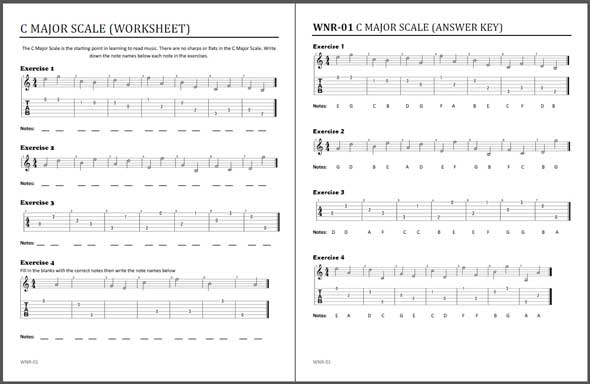
Members can now access guitar worksheets to print off and give to students. These worksheets are different than the guitar lesson plans currently available. Worksheets are focused on a very narrow topic and require the student to answer questions on the sheet. The example below is a worksheet on identifying the notes in the C Major Scale. This worksheet asks the student to identify notes on the staff as well as on Guitar TAB. Each exercise will test the student out in different ways.

Guitar Worksheets

Each worksheet available for download contains an answer key which you can either give to your student after they fill out the answers or you can keep for your reference. On advanced topics having a worksheet saves you from having to figure out all the answers on your own.

The new worksheets will be available in the Lesson Materials Section below the standard guitar lesson plans. We will continue to create both resources so you always have different materials to work with.

The first worksheet available, WNR-01 Random Notes C Major Scale is available now. Print it off and give it to your student and see how well they do. A simple test like this one is a great way to see what areas your student needs to work on.

WNR-01 Random Notes C Major Scale

About this worksheet

This worksheet will give your student practice reading both standard notation and Guitar TAB. They will learn to recognize the notes in the C Major Scale across the first four frets on the guitar. They will also have practice in writing in the correct notes in the staff as well as in Guitar TAB. This will be the first time many students have properly studied written music so encourage your student to take their time and not to worry if they make mistakes.

Worksheets like this one works best if you give it to the student at the end of a lesson and ask them to try to fill it out during the week and bring it back in next lesson. This will give them a chance to figure out the answers on their own and you can provide essential feedback in the next lesson. An Answer Key is provided if you need it.

Only Live and Teach Guitar Members have access to this resource and all other resources on the site.

If you're a member, please login to access this resource

If you're not a member yet, find out how our professional materials, resources and support can help you succeed as a guitar teacher here.

Please login or register to gain full access now

Related lessons

BEG-05 How to read Standard Notation

New lesson material: Guide tones

A new guitar lesson plan has been included in the Lesson Materials Section on guide tones. Guide tones will help your student improve their improvisation by selecting certain notes that compliment the backing chords. Once your student learns to use guide tones effectively, their confidence in their improvisation skills will increase. Your student will be able to come up with more interesting solos and sound more 'musical'.

Access the lesson here: INT-09 Guide Tones

More teaching resources are available in the Lesson Materials Section here.

INT-09 Guide Tones

About this lesson

Guide tones will help your student transform their improvisation skills to a whole new level. Using guide tones can help the student target notes that will bring out the interesting qualities of the underlying chords. If your student is getting bored with basic Pentatonic Scales and doesn't feel like they're creating interesting sounding licks, this lesson will give them something new to work with. Most students will understand guide tones without much explanation but it's still a good idea to explain the theory in a lesson before looking at this content. This lesson plan contains a chord progression using guide tones and then gives an example on how the student could apply the guide tones in their music. The included lesson instructions clearly explains the concept in simple terms.

This lesson plan will help your student:

  • Build a stronger understanding of chords
  • Learn to choose notes that bring out the unique qualities of chords
  • Improve their improvisation skills
  • Create more interesting solos and licks

Only Live and Teach Guitar Members have access to this resource and all other resources on the site.

If you're a member, please login to access this resource

If you're not a member yet, find out how our professional materials, resources and support can help you succeed as a guitar teacher here.

Please login or register to gain full access now

Related lessons

MTH-07 Major Scales and Key Signatures

MTH-08 Seventh Chords

New lesson material: Seventh Chords

A new lesson plan has been added to the Lesson Materials Section on seventh chords. This lesson plan will explain the main types of seventh chords including the theory behind the chords. Your student will learn how to identify each type, figure out the chord positions based on either a basic major or minor chord and even learn how to create arpeggios across the neck.

Be sure to cover the basic theory behind the Major Scale before using this lesson plan. Beginners may have trouble understanding the theory if they have not yet learned about intervals so be sure to cover that as well.

Access the lesson here: MTH-08 Seventh Chords

There are more lesson plans available on music theory under the MTH series. Check out the Lesson Materials Section to access more lesson plans.

MTH-08 Seventh Chords

About this lesson

This lesson plan will introduce your student to seventh chords. The three basic forms of seventh chords are explained in detail with diagrams. The included lesson instructions will help you explain the theory in the easiest way possible. Beginners often get confused when trying to understand the difference between Gmaj7, G7 and Gm7 so this lesson is focused on making the differences easy to understand. It's recommended you spend some time teaching your student some basic music theory before explaining seventh chords. You can use lessons MTH-01 and MTH-07 to cover the basic theory first.

This lesson plan will help teach your student:

  • How to identify the different types of seventh chords
  • Understand the theory behind each chord
  • Figure out seventh chord positions based on Major and minor chord shapes
  • Form arpeggios across the neck

Only Live and Teach Guitar Members have access to this resource and all other resources on the site.

If you're a member, please login to access this resource

If you're not a member yet, find out how our professional materials, resources and support can help you succeed as a guitar teacher here.

Please login or register to gain full access now

Related lessons

MTH-01 The Major Scale

MTH-07 Major Scales and Key Signatures

You own website

Attract new guitar students using three effective methods

Learning how to attract new guitar students whether you're just starting out as a guitar teacher or looking at growing your student base is extremely important. Many tutors still think that paying for advertising in the local paper is the best way to attract new guitar students. The truth is an ad in the local paper is possibly the worst possible strategy. In this short post we will look at three effective ways you can attract new students right now.

Leverage the power of Facebook and other social media

If you're already on Facebook then you know how popular it is and how many people use it regularly. If you aren't on Facebook then you might be surprised to know that the number of active Facebook users is almost 1 billion (as at July 2012). This provides a massive opportunity for you as a guitar teacher. At any one time it is likely that somebody in your area is on Facebook and wants to find a guitar teacher. If you have a strong online presence then you have a very good chance of that person contacting you. You can use other social media such as Twitter, Google Plus, etc. but we have found Facebook is the most effective way to find new students.

So how can you use Facebook to attract new guitar students? We've created two detailed guides to help you leverage the power of Facebook and attract new students. BMK-06 About Facebook will explain Facebook in detail and how it can bring you new students. BMK-07 Facebook Marketing Strategies spells out two specific strategies you can implement straight away to attract students. The strategies are explained step by step with details on why they work.

Create your own website so people can find you

There's a powerful reason why every brand has their own website - it gives the brands the power to control their marketing material and attract new customers. You can have the same power.

Let's run a simple test - go to Google and search for "guitar lessons in 'xxxx'. If you live in San Diego you would search for 'guitar lessons in San Diego'. What shows up in the results? Are you in the top 10 results? 20? 30? If you teach guitar in San Diego and you aren't Paper Moon Music then you're going to have a really hard time finding new guitar students because anybody searching for lessons in San Diego are straight away going to click Paper Moon Music's link which will take the person straight to their site and not yours. If you knew how many thousands of searches like this one are done every month for your home city you would realize the importance of having your own website.

You don't need a complicated site with all the bells and whistles - all you need is something for people to find you and contact you. If people can't find you then they won't contact you. It's as simple as that. Having your own website will greatly improve the odds that somebody searching for guitar lessons in your home city will bring them to your site and contact you.

As guitar teachers we understand how important it is to have your own website so every Live and Teach Guitar Member can set up their own website at no cost. We can also provide support to help you set the site up as well as assist you in promoting your site and find new guitar students.

You own website

Setting up your own website will help you attract new students for years and years at no extra cost.

Word of mouth is the most powerful marketing tool for guitar teachers

As a guitar teacher your most powerful marketing tool is word of mouth. If people hear that you're a great teacher they will be more likely to contact you for lessons or tell somebody else to contact you. If you do a good job with your current guitar students they will let other people know and spread the word. Alternatively, if you do a poor job with your current guitar students they will also spread the word - but this time it won't be positive. A guitar teacher who cuts lesson times short, wastes time during the lesson and teaches the student stuff they don't want to learn will soon gain a poor reputation. People will hear about it. So just remember in every lesson that it's very likely your student will tell others what they think of you. Make it a good impression.

There are specific ways you can spread the word and encourage word of mouth. We have written a detailed guide to help you use word of mouth effectively and included a case study to see how it works in action. Check out BMK-05 Word of mouth marketing strategies for effective strategies you can use straight away.

Get started and attract new guitar students now

The best part about these strategies is that they take little effort to get started and almost no effort to continue over the years. Taking ten minutes to set up a website today can bring you new students for years. Compare that to spending money every week in a newspaper ad nobody will see. If you take the time to get these strategies started you will quickly see how effective they are in bringing you new guitar students and how they will continue to bring you new students again and again.

Want to teach your student how to play the blues?

The blues is easy to teach and students love being able to play the simple rhythms and play easy blues licks. You can use BLU-02 to teach your student how to improvise and BLU-03 to teach your student how to play the 12 bar blues shuffle. More