
Guitar Lesson Plans for Kids

New guitar lesson plans for kids

We've been working hard on creating effective guitar lesson plans for kids. Unlike other students, young kids have special requirements and require extra motivation and incentives to practice. We've tested quite a few different options and developed two new series of guitar lesson plans you can use with your children students.

In-build incentives in our guitar lesson plans for kids

From our testing we've found that including a simple incentive within the actual lesson plan dramatically improves the student's motivation, focus and effort. Each guitar lesson plan we develop for children will use some form of incentive to maximize this effect. One of the most effective inbuilt incentives we have developed is the reward that students can color in drawings on the lesson plan after they successfully learn the songs.

This means the student has an extra incentive to practice hard and learn the entire song. Instead of learning it for a bit, getting bored and moving on to the next song, they will have an extra reason to keep practicing. After the student learns the entire song and receives their reward (the coloring in), we've found that the benefits continue. We've found that students 'take ownership' of the song and their colored in lesson plans. They continue to practice the song and every time they see their colored in work, it reminds them of the benefits of practice.

While the inbuilt incentives we have developed in our guitar lesson plans may seem simple, they're very effective. We're constantly testing out different variations and forms of incentives and you will see more of these in future lesson plans.

The KID guitar lesson plans

The KID guitar lesson plans will focus on worksheets and trackers you can use to get your student involved with guitar. They will be very interactive and use inbuilt incentives to encourage the students to practice as mentioned above. Here's the first resource in this series and more are being worked on right now.

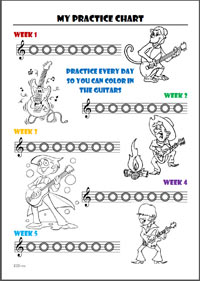
KID-01 Practice ChartGuitar Lesson Plans for Kids

This simple resource will help you develop a daily practice habit in your students. The resource covers five weeks of practice and uses effective incentives after each week so you can see how the student is tracking. The great thing with using this resource is that after the first five weeks, the student will have developed their daily practicing habit so much they will continue to practice without any extra incentives. Of course every student is different but we've tested this with many children and found it very effective.

The KDS guitar lesson plans

The KDS series of guitar lesson plans will focus on simple children's songs. Each song will teach the student how to play the single note melody while gently incorporating more difficult concepts such as partial chords, rests, muted hits, etc. Each song displays the backing chords so you can accompany the student. As mentioned above, the inbuilt incentives in each guitar lesson plan will encourage the student to practice on their own. The simple rewards reinforce good behavior and develop good habits.

KDS-01 Baa Baa Black Sheep

KDS-02 Eensy Weensy Spider

KDS-03 It's Raining, It's Pouring

KDS-04 If You're Happy And You Know It

More songs will be added to the Lesson Materials Section over this and future months as we develop more effective incentives and layouts.

KDS-04 If You're Happy And You Know It

About this lesson

This guitar lesson plan teaches the children's song 'If you're happy and you know it'. The song uses a single note melody with the occasional partial chord. A shuffle rhythm is used in this song along with muted hits to be played in place of clapping. Alternatively, instead of the muted hits you could tell the student to clap their hands. This would be tricky but can teach the student how to start and stop quickly. The lyrics are given along with the music so the student can match up the words to the notes they play. Chords are given so you can accompany the student.

This lesson plan uses an inbuilt incentive to encourage the student to practice the song. At the bottom of the page there is a line drawing of clapping hands and a smiley face. The idea is that once the student can properly play the entire song, they have your permission to color in the drawing and to draw more smiley faces across the page. This simple incentive can make a big difference to the student's motivation. Instead of merely learning the song, they have an extra reason to practice. Even know the reward might seem trivial, it does help. Once the student learns the song and draws the faces as per your instructions, they will take 'ownership' of the song and be more likely to keep practicing it. Every time they see their colored in drawing it will remind them of the reward for practice.

Only Live and Teach Guitar Members have access to this resource and all other resources on the site.

If you're a member, please login to access this resource

If you're not a member yet, find out how our professional materials, resources and support can help you succeed as a guitar teacher here.

Please login or register to gain full access now

KDS-03 It's Raining, It's Pouring

About this lesson

This guitar lesson plan teaches the children's song 'It's Raining, It's Pouring'. The song uses a single note melody with the occasional partial chord. This is a great way to introduce your student to chords that use one or two fingers at a time. The lyrics are given along with the music so the student can match up the words to the notes they play. Chords are given so you can accompany the student.

This lesson plan uses an inbuilt incentive to encourage the student to practice the song. At the bottom of the page there is a line drawing of an old man in bed along with clouds across the page. The idea is that once the student can properly play the entire song, they have your permission to color in the drawing and to draw rain down the side of the page out of the clouds. The student can even draw in their own clouds around the page. This simple incentive can make a big difference to the student's motivation. Instead of merely learning the song, they have an extra reason to practice. Even know the reward might seem trivial, it does help. Once the student learns the song and draws the rain as per your instructions, they will take 'ownership' of the song and be more likely to keep practicing it. Every time they see their colored in drawing it will remind them of the reward for practice.

Only Live and Teach Guitar Members have access to this resource and all other resources on the site.

If you're a member, please login to access this resource

If you're not a member yet, find out how our professional materials, resources and support can help you succeed as a guitar teacher here.

Please login or register to gain full access now

MTH-05 Intervals

About this lesson plan

This is a handy lesson plan to use when you want to discuss intervals with your student. All the intervals up to an octave are provided in both melodic and harmonic forms. The included Teacher's Guide will suggest a simple way you can discuss all intervals with your student. It's recommended you go through each interval with your student rather than merely provide this as a reference sheet.

If you spend the time and effort teaching the importance of learning intervals, your student will begin to understand chords, scales and songs better. You can even use this lesson plan as the starting point for ear training. Teaching your student to identify the different intervals by ear is a fantastic skill.

Only Live and Teach Guitar Members have access to this resource and all other resources on the site.

If you're a member, please login to access this resource

If you're not a member yet, find out how our professional materials, resources and support can help you succeed as a guitar teacher here.

Please login or register to gain full access now

KDS-02 Eensy Weensy Spider

About this lesson plan

This lesson covers the children's song 'Eensy Weensy Spider'. The song uses a single note melody with the occasional partial chord. This is a great way to introduce your student to chords that use one or two fingers at a time. The lyrics are given along with the music so the student can match up the words to the notes they play. Chords are given so you can accompany the student.

This lesson plan uses an inbuilt incentive to encourage the student to practice the song. At the bottom of the page there is a line drawing of a spider. The idea is that once the student can properly play the entire song, they have your permission to color in the drawing and to draw rain down the side of the page washing the spider away. Then you can tell the student to draw a big yellow sun on the top of the page. This simple incentive can make a big difference to the student's motivation. Instead of merely learning the song, they have an extra reason to practice. Even know the reward might seem trivial, it does help. Once the student learns the song and draws the rain as per your instructions, they will take 'ownership' of the song and be more likely to keep practicing it. Every time they see their colored in drawing it will remind them of the reward for practice.

Only Live and Teach Guitar Members have access to this resource and all other resources on the site.

If you're a member, please login to access this resource

If you're not a member yet, find out how our professional materials, resources and support can help you succeed as a guitar teacher here.

Please login or register to gain full access now

KDS-01 Baa Baa Black Sheep

About this lesson plan

This lesson covers the song 'Baa Baa Black Sheep'. The song uses a single note melody with the occasional partial chord. This is a great way to introduce your student to chords that use one or two fingers at a time. The lyrics are given along with the music so the student can match up the words to the notes they play. Chords are given so you can accompany the student.

This lesson plan uses an inbuilt incentive to encourage the student to practice the song. At the bottom of the page their is a line drawing. The idea is that once the student can properly play the entire song, they have your permission to color in the drawing. This simple incentive can make a big difference to the student's motivation. Instead of merely learning the song, they have an extra reason to practice. Even know the reward might seem trivial, it does help. Once the student learns the song and colors in the drawing, they will take 'ownership' of the song and be more likely to keep practicing it. Every time they see their colored in drawing it will remind them of the reward for practice.

Only Live and Teach Guitar Members have access to this resource and all other resources on the site.

If you're a member, please login to access this resource

If you're not a member yet, find out how our professional materials, resources and support can help you succeed as a guitar teacher here.

Please login or register to gain full access now

KID-01 Kids Practice Chart 1

About this resource

Motivating young children to practice regularly can be a difficult task. Unless the right incentives are given, you may find some children don't practice at all between lessons. This practice chart will help you keep track of how your student practices as well as providing them incentives to practice every day.

The inbuilt incentives in this chart work by setting a hurdle the student must pass before they receive a reward. In this case the hurdle is that they must practice every day for seven days. At the end of the seven days provided they have practiced every day, they can color in a drawing on the chart. This is the incentive. The student is rewarded for their consistent practice with a coloring in drawing.

A new drawing is provided in the following weeks for five weeks to set the habit of regular practice. This incentive has been tested and works extremely well for young children. During each lesson you can provide positive feedback to encourage the student to continue practicing every day. You can also comment on their coloring in skills which reinforces the reward for next week.

For this incentive to work properly, you must tell the student's parents that they should keep track and make sure the student doesn't cheat by marking off days when they haven't practiced. After five weeks of consistent practice it will become a habit and you won't have to focus on it so much. The student will be used to practicing every day and you can use different incentives such as games or songs the student likes.

Only Live and Teach Guitar Members have access to this resource and all other resources on the site.

If you're a member, please login to access this resource

If you're not a member yet, find out how our professional materials, resources and support can help you succeed as a guitar teacher here.

Please login or register to gain full access now

Updates: Best practices, psychology and Keith Richards

We're spreading our reach to a new guide series and starting to cover best practices from expert teachers so you can quickly develop your abilities. Here's our latest resources:

PRO-09 Keith Richards

This 'in the style of' lesson will introduce your students to Keith's rhythm style. A couple of the examples use Open-G tuning so it's a great way to introduce alternate tunings to your student at the same time.

SCA-11 Modes Reference

This is a simple reference sheet containing the seven modes of the major scale. Your student will be able to easily compare the modes and learn the intervals in each one. This will work best when used in combination with the individual modes lesson plans (SCA-04 - 10)

New Psychology Series (TPS Series)

This series takes the findings from a wide range of psychology studies to improve the quality of your teaching. When you learn to understand how students think, you can create a better learning environment.

TPS-01 Understanding Needs

You need to understand your student's needs before you expect to give a quality lesson. This guide will break down the way all humans' needs work and what you should watch out for in your lessons. Teachers who don't bother reading up on this topic end up experiencing issues that could have been easily avoided.

TPS-02 Body Language

This guide will teach you how to read your student's body language so your lesson can remain relevant and interesting. Plenty of examples are given so you can easily gauge the student's interest levels and adjust course if you need to.

TPS-03 Structuring Your Lesson

While you have a lot of flexibility in how you give a lesson, all lessons should follow the basic structure given in this guide. The reason is because it has been tested and results in a better learning environment for your student. Whether you're a new teacher or have been teaching for decades, it's essential you read this guide and follow the advice given.

TBE-02 Eliminating Points of Failure

A Point of Failure is something that can drive your student to giving up guitar. Sometimes it only takes one Point of Failure for the student to completely give up and leave your lessons. By learning to identify these Points of Failure in your teaching style and eliminating them, you will retain more students and keep your students motivated.

SCA-11 Modes Reference Sheet

About this resource

Along with the individual lesson plans on the modes (SCA-04-10) this sheet is a great way to compare the modes on one sheet. The formula for each mode is written out so you can show the student the different interval changes from mode to mode. This will make it easier to explain the difference between the modes and how they sound. Using this reference sheet in combination with the individual lesson plans on the modes will get the best results.

Only Live and Teach Guitar Members have access to this resource and all other resources on the site.

If you're a member, please login to access this resource

If you're not a member yet, find out how our professional materials, resources and support can help you succeed as a guitar teacher here.

Please login or register to gain full access now

Related lessons

SCA-04 - 10

TPS-03 Structuring Your Lessons

About this guide

In this guide you will learn how to structure your lessons in such an effective way that your students will stay motivated during the lesson and retain more information after the lesson is over. This structure is very flexible and provides you with a 'blueprint' you can use for all your lessons.

For new guitar teachers this guide will give you a great starting point to make sure your lessons are effective straight away. You won't need to go through the long trial and error process most teachers go through to figure out how to structure your lessons effectively. By the end of this guide you will know exactly how to structure your lessons.

For experienced guitar teachers this guide will help you refine your lessons and give you ways to improve the structure of your lessons. You will already be loosely following this structure but may not fully understand why the structure is effective. This guide will explain why along with provide suggestions on ways you can improve your lessons.

Why Structure Matters

Consistency is important in a learning environment. From a student's point of view it helps if each lesson is structured in a similar way so they know what to expect. Having consistent lessons improves the learning process for your student and makes your job easier. You still need to be flexible in your approach and this structure will still provide you with flexibility as you need it.

A student who arrives at each lesson not sure of what is going to happen or why they are learning the material will have trouble developing. On the other hand a student who arrives at each lesson knowing roughly how the lesson will be structured will be able to focus 100% on the actual content instead of being confused. A well thought out structure can make a big difference to the learning experience.

Only Live and Teach Guitar Members have access to this resource and all other resources on the site.

If you're a member, please login to access this resource

If you're not a member yet, find out how our professional materials, resources and support can help you succeed as a guitar teacher here.

Please login or register to gain full access now